

For those unable to hold the content of a monthly newsletter doing a system’s change deep dive at the front of mind. Check out the archive for parts 0 - 9.
A meticulously minuted running order looks good on paper. But even if you account for everyone being caffeinated enough to contribute, you are still one wordy ramble away from an agenda that no longer fits the room.
This is why experienced facilitators build in slack. A plenary discussion that could stretch, an activity that could be compressed without anyone noticing. To the untrained eye it looks like empty space. Without it you’re setting yourself up for failure.
Much like stock sitting in a supermarket warehouse. Nobody notices. Until the shelves are empty.
It’s said that any society is only nine meals away from revolution. And history has a habit of making it sound less like hyperbole.
Buffers and stabilisers are taken for granted in normal times and noticed only when they run out. Then everybody notices at once.
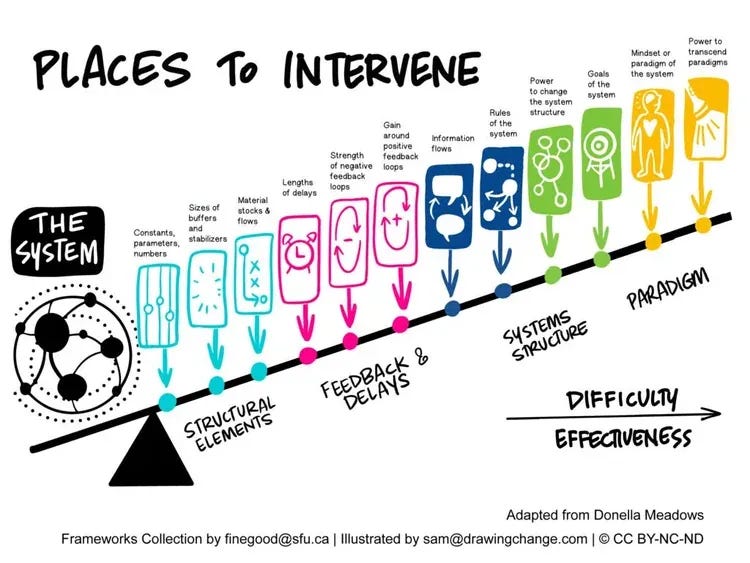
For the unacquainted, this series has been working down Donella Meadows’ leverage points, asking at each one what it would take to tilt a system towards one that is citizen led. Which brings us to leverage point eleven: the sizes of buffers and other stabilising stocks, relative to their flows.
A buffer is a reserve held against the gap between what flows in and what flows out: a reservoir, a grain store, a savings account, a spare ten minutes in an agenda. Crucially, a buffer tells you nothing about where a system is heading or what it is for. A reservoir running dry might show something has gone wrong. The return of regular rainfall restores the balance without changing anything.
Buffers do not change a system. They decide whether there is a system there to change.
That is why they are easy to underestimate, and why they matter more than their place suggests. They do the real load-bearing work. Many of those that stabilise the current system are what is keeping people fed, housed and paid.
It is tempting to think that if you want the system to change, they are also part of what has to go. However, simply removing them leads to collapse not transition.
This is not to undermine our participatory ambitions but to underline them. The irony of caution in the current system is that stabilisers are being dismantled by default.
Back in part two, I argued that the operative goal of the current system is stability through growth and efficiency. Efficiency has one great blind spot: a buffer, by definition, looks like waste. A fallow field is not a productive one and a public service with capacity to spare is one that’s waiting to be cut.
So over decades the slack has been squeezed out of supply chains, soils and public budgets. Stability has been pursued so narrowly that it has started to erode itself. What looks like efficiency is fragility.
The lesson here for us facing the future is that erosion cuts both ways. Thin buffers make the current system more likely to lose its legitimacy and create a space where foundational change becomes possible. But thin buffers in replacement also leave less room to imagine and build something new.
Which leaves this piece with two jobs. The first is to work out what the buffers of a participatory system actually are, and how empty they are right now. The second is to work out how to fill them, so the systemic changes further upstream can draw on them when a crisis hits.
More buffets than buffers
Most participation strategies are less a buffer and more a buffet: sample a little of everything on offer, fill up on the small plates, and assume there will always be time to go back for more later.
It is, in fairness, an immature system, more river than reservoir, running on the flow of each new commission rather than on anything held in reserve.
Four flows in particular carry most of the weight, and none of them is set up to withstand a serious shock.
1. Commitment: the single point of goodwill
In most participatory work, that stock is held in one person. There is nearly always a champion: a chief executive who gets it, a council leader who commissioned the thing. Everybody in this field knows the pattern, because they at some point have depended on one, and been grateful. They are the reason the process happened. They are also, in almost every case, the entire buffer.
The trouble is that a champion is a flow, not a stock. They arrive, they are enthusiastic, they are then promoted or worn out. The commitment they were carrying does not transfer to whoever replaces them as it was held in a personal relationship not a handover document.
Ahora Madrid built serious participatory infrastructure into the working of a city and watched it dismantled within months of losing an election. East Belgium wrote its citizens’ council into constitutional arrangements, and it has since run through changes of government that would have finished it anywhere else. One was a policy flow. The other was an institutional reserve.
2. Redundancy: one road in
This is the one I think the field underrates most. Boswell, Hendriks and Ercan describe three routes by which the outcome of a public deliberation can reach the institutions with the power to act on it. Existing government machinery; newly created formal forums with recognised standing; shared public discourse, where an idea travels through media, advocacy and ordinary conversation.
Most processes I have seen use one. The commissioning body receives the report, and that is the road. It is the shortest and cheapest road, with the fewest people to convince.
A single route is a single point of failure. Redundancy is a buffer, and its size is the number of independent routes by which an outcome can still arrive when one of them closes. A process with three roads in is not three times better than a process with one. It is categorically different, because the first survives a blockage and the second ends at it.
3. Memory: starting from zero
Almost every deliberative process in this country is convened from nothing. A secretariat is assembled, facilitators contracted, and methods chosen. Over several months a very large quantity of practical knowledge is generated about what worked. Then it ends, the team disperses, and most of that knowledge leaves in the heads of the individuals who acquired it. The next process starts from zero; a slightly better zero, because the sector talks to itself, but institutionally, zero.
The current system rarely starts from zero. Memory there is held by institutions designed to outlast the people passing through them.
A standing body is valuable because it is permanent. It accumulates method, relationships, credibility and precedent, and holds them somewhere that does not depend on any individual staying in post.
The real test is not how well it was designed on day one, but whether it has run long enough to absorb a few shocks that would have ended a one-off.
4. Trust: the shared account
Public trust in being asked is itself a stock. It fills slowly, but it can empty fast.
What makes it a systems problem rather than a reputational one is that the commissioner who spends that trust is almost never the one who needs it next. A local authority that runs a poor process has not only damaged itself; it has drawn down a shared account that the next iteration was relying on.
The cost is real and it is transferred, and nothing anywhere in the system makes anybody account for it. It is no accident that political participation is lowest in places that learned that giving their opinion rarely changes anything.
Filling the reserves over time
Meadows put buffers low on her list partly because they are usually physical, expensive and slow to change; nobody enlarges a reservoir overnight. Even though most participation buffers are made of belief and paper, so are easy enough to manifest. The stock fills at the speed of its inflow, so the work is less a single intervention than a sequence that takes shape over years.
At the heart of it is response architecture: the arrangements that determine what happens to a recommendation.
It starts small, with individual commitments on individual processes, each one a tributary. On their own they trickle, but connected to something built to receive them, they begin to fill a reservoir that no single champion, budget line or commission could fill alone.
Write the response down before the process starts. Not what it will decide; how it will account for what it decided. This is available to every practitioner reading this, on the next piece of work. It costs a paragraph in a contract that is being written anyway, and it converts a stated intention into a written obligation that outlives the person who stated it.
Owe reasons, not agreement. Participants are not owed a yes. They are owed reasons.
That points towards a tiered arrangement rather than a binary one. At minimum, every recommendation is formally discussed rather than received; above that, a public, reasoned, item-by-item response within a fixed window, with the reasoning set out for anything rejected. One step further would be assigning further deliberation and co-design on proposals that have been rejected to work on how to feasible bring them into practice.Build more than one road. Send the outcome to the committee and the regulator and the press and the sector at the same time, as a design decision rather than a fallback once the first route stalls.
Make somebody watch the level. Independent tracking of what happened to recommendations, published on a schedule, is what makes every arrangement above it real rather than decorative. Done across commissioners rather than within one, it is also the nearest thing the shared trust account has to a guardian; a public record of who drew down and who paid back in.
Let the memory accumulate. The standing body is the slow end of the sequence, and the one fewest of us can create directly. But the stock it holds can start smaller than an institution: a retained bench of facilitators, a network of past participants, a shared log of methods and what happened to their outputs, kept somewhere the next team can find it. None of these is a citizens’ council. Each is a reserve that does not reset to zero when the contract ends.
What we are actually building for
Every leverage point above this one has been about making a system better: shifting the paradigm, naming the goal, rewriting the rules, opening the information flows, all of it aimed at changing what a system does and who it does it for.
This one is not about better. It is about lasting.
A participatory system that runs beautifully for three years and then stops is not a success. It is a system that was never built to survive. The work will not be judged on whether it held while the river ran high. It will be judged on what was left when the rain stops falling.
It’s up to us to begin the slow, intentional practice of building up the reservoir to deepen the possibility of a participatory future.
So where does the commitment live in the processes you are part of? If the person who championed it left tomorrow, what would still be standing in six months? And what would it cost, in practice, to write one thing down before the next process starts?
Next month I finish this series with the final leverage point: constants, parameters and numbers. We arrive at last at the place most political conversations start. The dials, thresholds, percentages and budget lines, and why changing them almost never changes anything.
These reflections are very much a work in progress, often emerging as they are written. They are offered as provocations rather than prescriptions. Challenge, critique, and invitations to build something better together are wholeheartedly welcome.
Would love to hear from you, and if you know anyone who imagines a better, participatory future, please share.