

For those unable to hold the content of a monthly newsletter doing a system’s change deep dive at the front of mind. Check out the archive for parts 0 - 7.
“We don’t have time to ask people.”
I have heard that objection more times than I can count, from commissioners, sceptics and myself.
The sentence arrives with the weight of obvious common sense. There is a decision to be made, the clock is running, and bringing more people into the room can only slow things down.
Participation, on this account, is a luxury good. Affordable when the stakes are low and the calendar is open, unaffordable the moment things speed up. The faster the world moves, the argument goes, the less time there is to decide together.
It is a reasonable-sounding objection, and one that has more impact than it pretends to.
Because folded inside that sentence is a claim about how long good decisions take, how fast the world moves, and who can be trusted to keep up.
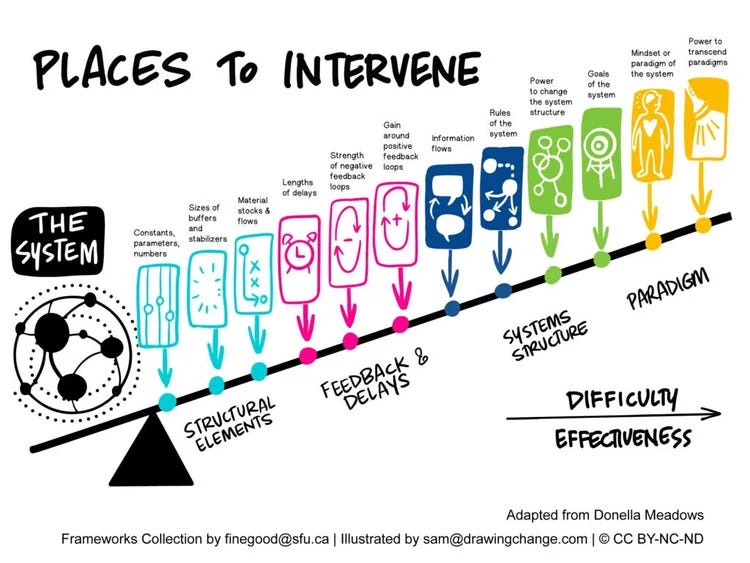
We have reached the length of delays, ninth on Meadows’ list, below paradigms, goals, structural conditions, rules, information flows, and the feedback loops that the last two issues have covered.
By now you will know that further down the seesaw does not mean marginal. It means the work happens in concert with everything above it, rather than announcing itself as transformation.
Which is just as well, because it is only by delving into the unglamorous end of leverage points that we can determine whether anything upstream can accumulate at all.
The gap between acting and knowing
Anyone who has facilitated online will know the particular misery of a call with lag. Two people start speaking at once, both stop to let the other in, both start again, both apologise, both wait, and the silence stretches until someone risks it and the collision repeats.
Nobody is being rude and nothing is broken. Each person is simply responding to where the conversation was half a second ago, never to where it is now. Half a second of delay, in a system that moves at the speed of talk, is enough to turn two people who agree with each other into a pile-up.
That is what the length of a delay is. The time between an action and the feedback that tells you what the action did.
And once you start looking, the lag is in systems everywhere, most often stretched over years rather than half-seconds.
The lag between dumping a pollutant and finding it in the groundwater. The lag between cutting a service and the harm surfacing some years later. The lag between raising interest rates and the economy actually responding. The lag between a policy and its consequences arriving just in time for the next government to take credit.
In each case the system is stuck on that laggy call, responding to where things were, apologising, and starting again at the wrong moment.
The crucial thing is that speed is a feature not the answer. A delay only matters relative to the rate of change in whatever it is trying to control. A long delay is no trouble in a slow system. A short delay can be a catastrophe in a fast one. There is no good or bad length in the abstract. There is only matched and mismatched.
A delay only matters relative to the rate of change in whatever it is trying to control.
Slow compared to what
When we are talking about decision making, the need for speed is hiding at least four different delays, and they do not behave the same way.
The decision delay. The time it takes to reach a choice.
The implementation delay. The time between the choice and anything actually happening.
The correction delay. The time it takes to notice a decision was wrong and change course.
The reversal delay. The ease with which a decision, once made, can simply be undone by whoever comes next.
The complaint about participation is almost always a complaint about the first of these, and only the first. Deliberation does lengthen the decision delay; gathering people, giving them evidence, letting them argue it through and change their minds takes longer than a memo.
But a process worth the name tends to shorten the other three. It surfaces the objections that would otherwise have ambushed implementation later. It builds the shared understanding that lets people spot when something is going wrong and say so. And because the people affected helped shape the thing, it is far harder for the next administration, or the next restructure, to bin it.
So the honest version of the trade-off is not slow versus fast. It is a longer wait at the front in exchange for a shorter, stickier path to a stable outcome. A unilateral decree is quick to issue and quick to reverse. It’s noise without impact.
Participation is slow to begin and slow to undo, which is a polite way of saying it holds. For a public body, the only speed that finally matters is the time it takes to reach an outcome that survives contact with reality. Measured that way, the quick decision is frequently the slow one.
Take carbon taxes. Two neighbouring countries reached for the same instrument at the same moment and only the process differed.
In late 2018, the French government announced a fuel tax rise by decree, effective within weeks. The gilets jaunes filled the roundabouts, the increase was suspended, then scrapped, and France’s carbon price has been frozen ever since. One fast decision, and the entire trajectory stalled for the best part of a decade.
Ireland ran the same policy through its Citizens’ Assembly, where 80 per cent of members recommended higher carbon taxes; not because citizens enjoy paying more for petrol, but because they had sat with the evidence and the trade-offs. A cross-party committee carried the recommendation into law, and the tax has risen every year since, through an energy crisis, a cost-of-living crisis, and a change of government, on a legislated path to €100 per tonne by 2030.
The decree took weeks to make and weeks to die. The deliberation took two years and is still compounding.
The charge of slowness is real; it has just been pointed in the wrong direction all along. And finding where it actually belongs means dealing first with an assumption about where participation sits politically.
The slow architecture is the centralised one
There is a lazy assumption about where participation sits politically. That wanting more voices in more decisions is code for wanting more progressive policies, which gets filed, in the binary that swallows most political conversation, under ‘the left’, with the further insinuation that what is really being argued for is centralised state control.
The binary does not fit. Participation advocates are, of necessity, among the sharpest critics of centralised planning, and the reason is not ideological. It is delay.
A massive central planning system functions poorly for the same structural reason whether it is a Soviet ministry or a corporate headquarters. In centralised, hierarchical systems, information has to travel up through layers, get simplified at each one to stay legible, and travel back down again, by which point the situation it described has moved on.
Public institutions are the usual suspects here, and often deservedly so, caught in habits of internal dysfunction while their purpose points outwards. But this is not a disease of the public sector. It is a disease of distance, and it afflicts any organisation built as a tall pyramid with the deciding done at the top.
The centre governs through a stripped-down map of reality, because a map is the only thing it can hold, and the distance between the map and the territory is itself a kind of delay.
The forest looks healthy on the spreadsheet long after the soil has given out. The store looks profitable on the dashboard long after the customers have stopped coming back. The restructure looks rational at group level long after the people delivering the service could have told you which bits would break.
By the time the failure is legible at the top, it is no longer correctable at the bottom.
Distributed participation is, among other things, a way of shortening that distance. More people, closer to where the consequences land first, noticing the damp patch before the ceiling comes down. The frontline worker, the service user, the resident, the temporary citizen body convened on the exact question at hand; these are sensors, and a system with more of them feels its own mistakes sooner.
The thing routinely accused of slowing democracy down is one of the few mechanisms that lets a democracy detect, early, that it has been heading the wrong way. Centralisation is not the fast option, nor the effective option. It is the option that finds out last.
The centre governs through a stripped-down map of reality, because a map is the only thing it can hold.
When shorter delays make things worse
The accusation is dead: participation is not the slow architecture. That’s centralisation.
The temptation now is to bank the win and campaign on the reverse, that deciding together is actually the fast option. That would be repeating the exact mistake we have just diagnosed. Speed was never the ‘right’ goal; it is the current system’s goal, smuggled into the argument as though it were neutral.
A system’s goal is whatever it actually optimises when trade-offs appear, and a participation movement that starts optimising for pace has adopted the priorities of the thing it set out to replace.
Which is why the participatory pitch is not, and should never be, “we are faster”. It is “we are correctly paced”. Deliberation is a delay on purpose. It is the stretch of time in which people can actually change their minds, which is the one thing a poll can never give you and the one thing a hard problem actually requires.
Correctly paced does not mean uniformly slow, either. The caricature has participation as a fixed-size machine, a hundred citizens and a weekend of flipcharts wheeled out for every decision regardless of scale or urgency. It is nothing of the sort. Participation adapts its form to the decision at hand.
Matching the depth of deliberation to the pace and weight of the decision is not a compromise of the principle. It is the principle. This leverage point has been about matched and mismatched delays from the start, and participation done well is the practice of matching them. Slowness is not a bug that participation has failed to fix. In the places where it appears, it is load-bearing.
Which delays to change, and in which direction
If this issue has a practical core, it is that not all delay is equal. The work is to tell the useful ones from the harmful ones, and then act on the difference. From my perspective, these are the three delays which we should be laser-focused on to push our participatory ambitions up stream.
1. Attack the response delay.
The harmful delay, the one to go after without mercy, is the time between someone offering their input and ever hearing what became of it. You might recognise this as the advisory graveyard from the information flows issue, the place where well-reasoned recommendations go to be technically received and effectively ignored. When the loop never closes, people do the only rational thing and stop sending signals.
This delay is entirely of our own making, which also makes it the most shortenable thing in the whole system. Part of it is simply deciding to close the loop. Part of it is retiring the machinery that keeps it open: the sixty-page report that takes three months to draft and lands on a desk where nobody reads past the executive summary is not a feedback mechanism, it is a burial rite.
The tools now exist to do better. Practically speaking, capture the response while everyone is still in the room, share back what was heard before people have gone home and stopped believing it mattered, then iterate, and iterate again. The response delay survives on the assumption that reporting has to be slow. It does not, and every moment shaved off it is a month in which the people who participated still believe their signal is in transit rather than in the graveyard.
Incorporating this with purposefully designed tech tools is something specifically we are working on at Sorted Collaboration.
2. Protect the learning delays.
Some delays buy learning, and these are worth defending, even lengthening, because they are precisely the ones that responsiveness culture attacks first.
The deliberation itself is the obvious one. The gap between hearing evidence and forming a view is where minds actually change, and it cannot be compressed past a certain point without becoming something else. I’d highly recommend reading recent publication by Democracy Next on “Deliberative Muscles & AI”, which explores the need for deliberation to not just produce recommendations, but cultivate citizens.
The rotation tempo of sortition belongs here too, and it is the counterintuitive one, because rotation looks like an interruption. Just as a group finds its feet, it is dissolved and replaced. But that turnover is a learning delay running at the level of the institution rather than the individual: it refreshes the process before any group can harden into a fixture, before the confident voices calcify into an informal hierarchy.
At the same time, be purposeful about which topics need these delays at all. Learning time is a budget, not a virtue to be applied indiscriminately. The contested, the irreversible, the morally loaded, the decisions people will live inside for decades: these earn the full apparatus. The routine and the reversible do not, and pretending otherwise is how deliberation gets a reputation for ceremony. Spending the learning delay where it is not needed is its own kind of mismatch, and it hands ammunition to the mistrusting commissioner
Strip these delays out in the name of responsiveness and you do not get a more democratic system. You get a faster one that knows less.
3. Slow the rate of change itself.
This is the move that sticks in the throat, particularly for those of us who came to this work impatient for transformation. Very often the wiser intervention is not to speed up the response at all. It is to slow down what the system is being asked to keep up with, so that the delays you cannot remove stop causing so much trouble.
Inside an organisation or a public body this is unglamorous and familiar: pilot before you scale, phase a reform instead of detonating it, build in an honest review point, keep a rollback within reach. It can feel like a betrayal of urgency, an admission that change should wait. It is the opposite. You are not trying to wish the delay away. You are making the system move slowly enough that its own feedback can keep up, which is the only speed at which change actually sticks.
For those of us who design these processes, the responsibility is sharper. The most important question at the end of any participatory process is not what people decided. It is what exists to receive the answer, and how quickly the people who took part will see that their signal landed. Build that, and the longer wait at the front pays for itself many times over. Skip it, and you have simply added a delay to a system that will punish you for it.
The point of all this
“We don’t have time to ask people” is rarely the conclusion of an argument. It is the sentence that stops one from happening. It arrives before the analysis, sounds like realism, and closes the question of how a decision should be made in the time it takes to say it. That is what makes it worth this much attention: not that it is wrong, though it usually is, but that it is never asked to show its working.
The laggy Zoom call oscillated not because anyone on it was foolish, but because each person was answering a conversation that had already moved on. That is the failure this leverage point describes, and it is the failure most of our institutions are living inside. A fast decision wedded to a slow correction is the worst combination there is, and it is precisely what decisive, top-down governance tends to produce.
So the next time the sentence arrives, and it will, there is a sequence of responses available, and you can go as far as the conversation allows.
Start with that participation is slower to decide and quicker to be right. Add up all four delays rather than just the first, and the understanding flips. Measured across the whole life of a decision, deciding together is the faster architecture.
If that lands, go further. Centralisation’s claim to legitimacy rests on speed and decisiveness, and it turns out to be slow precisely where slowness does the damage. A system that loses on its own headline metric deserves scrutiny on all the others.
And if you have the time, and the patience, question the metric itself. Ask whether the system as it stands can feel the consequences of its own choices soon enough to act on them. Usually it cannot, and the person across the table knows it.
The question was never speed. It is always whether a system can sense what it is doing to itself in time to stop.
What compounds quietly today is what becomes unthinkable to reverse tomorrow.
These reflections are very much a work in progress, often emerging as they are written. They are offered as provocations rather than prescriptions. Challenge, critique, and invitations to build something better together are wholeheartedly welcome.
Would love to hear from you, and if you know anyone who imagines a better, participatory future, please share.
Next month we move one more step down the seesaw, to the structure of stocks and flows: the physical plumbing of a system, and why some things are so much easier to pour in than to pour back out.
Until then,
Ben
Participatory Future is one idea a month about how we make decisions together, worked through in public. It’s written from my experience of being in the room, not the library, and it’s free and will always be.
If you want to support the writing and keep it going into the future, you can buy me a coffee/beer. The gratitude will be realer than the caffeine hit.