

For those unable to hold the content of a monthly newsletter doing a system’s change deep dive at the front of mind. Check out the archive for parts 0 - 10.
As I enter my 35th year, despite the old political aphorism, I’m not a conservative and my brain is intact. However, signs are emerging. For one, the Financial Times is now my primary news source.
Although I’m not yet ready to sacrifice the participatory paradigm on the altar of fiscal responsibility. I do appreciate its well-constructured commentary and data driven deep dives. As an added bonus, I’m spared the violent fear-mongering of other front pages. In its place is an endless stream of numbers.
The UK economy is projected to grow by 0.1%; the Asian tech stocks have fallen 6%; bond yields are down 3%. It is a strange kind of news and a good insight into what the political and business elite obsess over and what keeps our current system in place.
The comfort of the dial
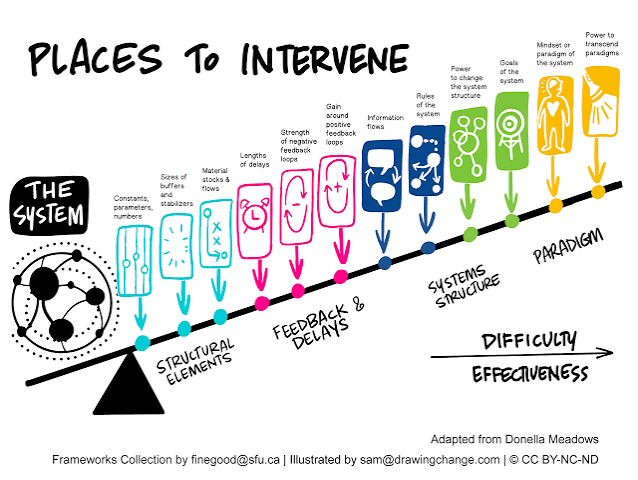
After ten issues, we have reached the bottom of Meadows’ systems leverage point - constants, parameters and the most familiar of the labels - numbers. It is the bottom rung, the least leverage, and the place where our political attention lives.
It is not hard to understand why. Numbers are legible in a way that paradigms and goals never are. They produce winners and losers and to the individual with more money in their pocket as a result, they matter enormously.
The trouble is that numbers rarely change how a system behaves. What makes the numbers game so comfortable, is it lets a system or more importantly an actor within it look busy without having to become anything different.
Numbers are excellent descriptors, provided they come with the right context. They pull the abstract down into something people can hold, weigh and argue about. Most of us could not explain how the bond market works, but after the autumn of 2022 we all know not to mess with it.
They also reinforce the technocratic paradigm, that our fate is better left in the hands who know this stuff. It is why numbers are so beloved by anyone trying to show they have command of a system. A figure delivered with confidence looks like control, whether or not the system underneath is listening.
The behaviours it promotes
The trouble is not the numbers themselves. The trouble is when they become the system’s steering wheel. Systems thinking puts them near the bottom of the leverage scale, yet much of our political and economic life is organised around them.
This isn’t only an indictment of the current system. Anyone who relies on numbers to steer a system has misunderstood how systems work. Numbers describe a system. They don’t move it. Ignoring this fact leads to two destructive patterns.
1. Short-termism
Every number comes with a clock attached, the window in which it is judged. That window is usually set by habit, such as quarters, months or four-year cycles, rather than by what the problem actually needs. The problems that matter run on a much slower clock. So the incentive is to make whichever move shifts the number in time.
The more often we measure, the shorter the window gets. And the shorter the window, the more attractive the quick win and the more expensive the long fix.
The deferred problems don’t disappear; they compound, and eventually they show up in the numbers anyway. The response is another quick turn of the dial to move the next figure.
The clock was meant to measure the system. It ends up setting the pace for everything inside it.
2. Goodhart’s Law
Goodhart’s Law puts it simply: once a measure becomes a target, it ceases to be a good measure.
The four-hour A&E target is a good example. To avoid breaching it, some hospitals found ways to stop the clock early, and ambulances were held outside with patients still inside so that it never started.
Nobody set out to make emergency care worse. The target simply became the thing the system was organised to maximise.
A number promoted to a goal does more than distort behaviour around itself. It narrows what the system can see. Whatever falls outside the measure becomes invisible, and a system cannot correct for what it cannot see.
When numbers climb the ladder
None of this means numbers never matter. Meadows’ own caveat is that they occasionally do, and those cases are instructive, because in each one the number is borrowing leverage from somewhere higher up.
This gives us a chance to look back up at everything this series has covered, and see how it reaches all the way down.
Because the point is not that numbers are useless. It is that they are only ever as powerful as the work done above them. A number on its own turns a dial. A number connected to a loop, a rule or a goal becomes a lever.
I can see three ways that connection happens: tipping points, defaults and triggers.
1. Tipping Points
Most numbers nudge. A few tip. Below a certain level nothing much happens; cross it, and the system starts behaving differently. This is essentially the bond market reaction triggered by Liz Truss’ economic policies.
This is the number borrowing from the positive feedback loops in Part 6. The threshold is the point at which a loop gets enough momentum to run itself.
Damon Centola’s research on social norms suggests that a committed minority of around a quarter of a group can be enough to tip a convention. Below that, the minority gets absorbed. Above it, the norm flips.
So the question is where the cliff edges of participation sit. How many people in a neighbourhood need to have taken part before it stops being unusual? How many assemblies does a council need to run before the next one is assumed rather than argued for? The Sue Effect is a loop, but every loop needs a first push large enough to get it turning.
2. Defaults
Every negative feedback loop has a setpoint: the number the thermostat keeps pulling the room back towards. As Part 7 argued, the loop is only as good as the goal it was built to serve. Change the setpoint, and the same corrective machinery starts working in a different direction.
A default is a setpoint for behaviour. It decides where things settle when nobody intervenes, and who has to make an effort to move them.
Pension auto-enrolment is a good example. When workers were moved from opting in to opting out, participation among eligible private-sector employees went from well under half to well over three quarters. Same people, same choices on offer. The system simply started correcting towards a different resting point.
The participatory equivalents are easy to imagine. A list of recommendations are enacted by default unless special measures are met. A decision that goes to a Citizens’ panel unless someone justifies not sending it. The burden of proof moves, and the system’s instinct to return to normal starts working for participation rather than against it.
3. Triggers
A trigger is a number wired to a consequence. Hit it, and something happens automatically.
Part 7 argued that once a threshold is crossed, deliberation should be triggered automatically rather than waited for. A trigger is how things become routine rather than a matter of goodwill.
The existing petitions threshold shows what happens when the wiring is missing. A hundred thousand signatures was once a trigger. Now it mostly produces a templated reply. The number stayed the same; what it was connected to fell away.
So the participatory ambition here isn’t to campaign for bigger numbers. The question to ask of any number is not how big it is, but what it is connected to. Does it tip a loop, reset a default or fire a trigger? If it does, it is worth fighting for. If it doesn’t, it is just another number that looks impressive but is untethered from changing a system.
A number only has leverage when it is wired into something further up the seesaw.
A game the rules are set to lose
When you work and campaign for more active citizen participation, it is tempting to make the case in the currency the system already accepts. More assemblies this year than last. A bigger slice of the budget allocated. Higher satisfaction scores and a better turnout.
The temptation is understandable, because it is the language the people holding the chequebook speak. Numbers feel like the price of being taken seriously, and so you have to learn to pay it.
The trouble is that arguing in parameters inside a system whose goal, rules and loops are set against you is a game you can win round after round and still lose. If participation is fought for at the level of the dial, it will be adjusted at the level of the dial, and the house, as they say, always wins.
Consider what that looks like in practice. Goodhart’s Law does not exempt the well-intentioned. Once the count of assemblies becomes the thing we report, the pressure is to run more of them rather than better ones. Once turnout becomes the headline, recruitment drifts towards the people easiest to reach rather than the ones the process most needs to hear from. Short-termism creeps in too: an assembly gets commissioned because it will report back before the end of the financial year, not because the question in front of it is ready to be answered. We end up optimising participation for the system’s clock and the system’s measures, which is not the way to go about changing either.
None of this means putting the spreadsheet away. The move is to keep counting while changing what the count is attached to. Make every figure you offer point back up the ladder to the tipping point, default or trigger that gives it consequence.
That way the number does what numbers do best, describing the system honestly, while the leverage sits somewhere the dial cannot reach.
The dial will always be there to turn. The work is deciding what it is connected to
What compounds quietly today is what becomes unthinkable to reverse tomorrow.
Next month, having reached the bottom of the seesaw, I’ll climb back up to the very top: the one leverage point above paradigms, the power to transcend them altogether.
Back in Part 2, I nodded at it and moved swiftly on. Had I started the series there, I suspect neither of us would have made it past the first page. It is hard to question a paradigm you have not yet taken apart.
Now I’ve got a year’s worth of musings to work with about where participation holds, where it gets absorbed, and where it quietly disappears.
So the question next month, having made the case all the way down, does the participatory paradigm hold up as something closer to the truth, or is it just the story I happen to find most convincing?
True to form, it’s probably somewhere in between.